
FY 2026-27: TDS Return Filing Deadlines for Deductors


Maintaining strict compliance with evolving tax regulations is fundamental to ensuring seamless business operations in India. Financial Year 2026-27 introduces pivotal structural updates to the tax ecosystem, making it essential for every business head and corporate taxpayer to thoroughly evaluate how these changes impact their financial structures.
Developing a proactive understanding of these revised compliance mandates ensures statutory alignment while effectively insulating your enterprise from penal risks and operational disruptions.
Recent regulatory amendments have introduced crucial shifts in statutory compliance. Transitioning to this updated reporting framework is essential, as relying on legacy filing methodologies increases the risk of reconciliation errors and data mismatches within your corporate systems.
To assist you in navigating these changes smoothly, this comprehensive guide breaks down the critical filing timelines, outlines the essential forms required for submission, and details the financial and legal implications of non-compliance.
Understanding Tax Deducted at Source (TDS)
Tax Deducted at Source (TDS) is a structural mechanism implemented by the IT Department to collect revenue directly at the point of income generation. Under this framework, the entity responsible for making a specified payment deducts a predetermined percentage of tax before remitting the net balance to the recipient. This source-level collection ensures a steady flow of revenue to the exchequer while minimising compliance defaults and simplifying the tax-paying process for individuals.
Under the provisions of the Income Tax Act, any individual, salaried employer, or corporate entity making a specified payment is classified as a deductor. The deductor is legally required to withhold a prescribed percentage of the payment as tax before remitting the net amount to the recipient, known as the deductee. Following this deduction at source, the deductor must deposit the collected tax with the government and file comprehensive quarterly statements (TDS returns) detailing these transactions.
Applicability
Tax Deducted at Source (TDS) regulations apply to various types of entities, including individuals, businesses, corporations, partnerships, and government agencies. Any person or organisation liable to deduct tax at source must obtain a Tax Deduction and Collection Account Number (TAN) and comply with applicable TDS provisions.
Additionally, individuals and entities subject to tax audit requirements, or those making specified payments exceeding prescribed thresholds, are required to adhere to TDS compliance obligations, including timely deduction, deposit, and reporting of tax.
The following are some of the most common transaction categories that require the deduction of Tax Deducted at Source (TDS).
Salary disbursements to employees
Professional and technical service fees
Contractor and subcontractor payments
Commission or brokerage payouts
Rent for land, buildings, or machinery
Key Compliance Due Dates Calendar
The TDS compliance framework operates through a two-tier system, requiring monthly tax deposits and the filing of quarterly TDS returns.
Quarterly TDS Return Due Dates
Quarterly returns must be filed electronically through the TRACES or Income Tax e-Filing portal after the end of each quarter within the prescribed TDS due dates.
Quarter Period | Due Date |
April 2026 to June 2026 | 31st July 2026 |
July 2026 to September 2026 | 31st October 2026 |
October 2026 to December 2026 | 31st January 2027 |
January 2027 to March 2027 | 31st May 2027 |
Monthly TDS Deposit Due Dates
Non-government deductors are required to deposit the tax deducted at source (TDS) with the government on or before the 7th day of the month following the month in which the deduction is made.
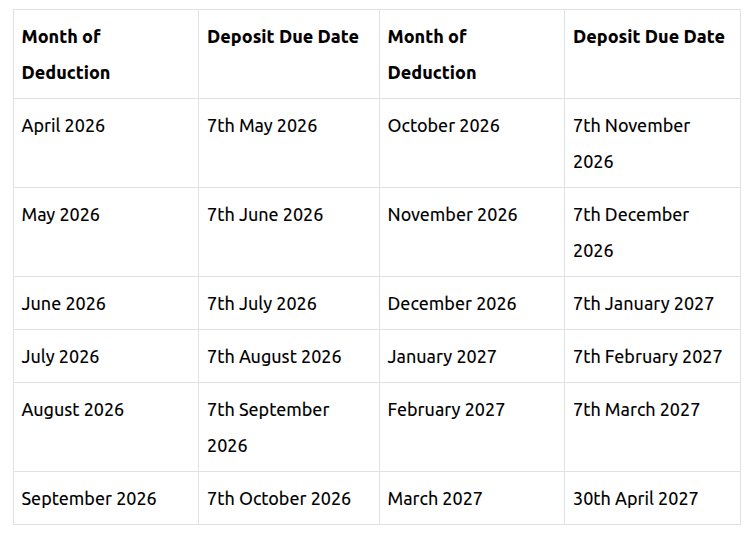
Note: However, there is a critical statutory contradiction in the second sentence. According to the Income Tax Department rules for government deductors paying via book entry (Treasury Challan), the deadline for March deductions is actually on or before 7th April of the same financial year (since the financial year ends on March 31st), or 7th April of the following assessment year. Saying "7 April of the following financial year" implies a 13-month delay, which is incorrect.
Comprehensive Return Filing Forms Suite
In today’s digital environment, income tax reporting has become more efficient through simplified and streamlined return forms. Ensure that your accounting and tax software is updated to support these latest forms, enabling accurate filing and seamless acceptance of your submissions.
Form 138 replaces the earlier Form 24Q for reporting TDS on salary payments.
Form 140 has replaced the earlier Form 26Q for reporting TDS on domestic non-salary payments.
Form 141 replaces the earlier Forms 26QB, 26QC, 26QD, and 26QE, consolidating the challan-cum-statement reporting requirements for specified property and other asset-related transactions.
Form 144 replaces the earlier Form 27Q for reporting Tax Deducted at Source (TDS) on payments made to non-residents.
Key Compliance Considerations
PAN Verification: Always verify the recipient's Permanent Account Number (PAN) before processing payments. Providing an incorrect, invalid, or inoperative PAN may result in tax being deducted at a higher rate as per applicable tax provisions.
Two-Year Correction Window: The CBDT allows a two-year window from the end of the relevant financial year for correcting errors in filed statements, including structural mismatches and incorrect PAN details. Once this period expires, no further modifications or corrections can be made.
Challan Matching: Before preparing and filing quarterly TDS returns, taxpayers and deductors should verify Challan details, ensuring that the Challan Identification Number (CIN) and tax amounts accurately match the records available on the Income Tax Department's portal.
Deductor Certificate Issuance Timelines: Deductors are required to issue TDS certificates to deductees within the prescribed timelines. For salary payments, Form 130 (which replaces the earlier Form 16) must be issued on or before 15 June following the end of the financial year. For non-salary payments, Form 131 (which replaces the earlier Form 16A) must be issued within 15 days from the due date of filing the relevant quarterly TDS return.
Late Filing Fees, Penalties, and Interest for Delays
Failure to comply with specified tax deadlines can result in significant financial penalties, interest charges, and other compliance-related consequences.
Get to Know About Late Filing Fees: Taxpayers who fail to file their returns within the prescribed due date may be liable to a late filing fee of ₹200 per day. However, the total fee cannot exceed the amount of tax deducted or collectable as reported in the return.
Payment of Late Filing Interest
If tax is not deducted within the prescribed time, interest at the rate of 1% per month or part thereof is payable. The interest is calculated from the date on which the tax was deductible to the date on which it is actually deducted.
Interest at the rate of 1.5% per month or part thereof is payable where tax has been deducted but not deposited within the prescribed due date. The interest is calculated from the date of deduction until the actual date of deposit.
Non-Filing Penalties: If a TDS return remains unfiled for more than one year from the original due date, a penalty ranging from ₹10,000 to ₹1,00,000 may be imposed under Section 271H of the Income Tax Act.
Overview of Interest, Penalties, and Prosecution Provisions

Key Takeaways
Staying compliant with tax regulations for FY 2026–27 can be challenging due to updated guidelines, revised forms, and evolving compliance requirements. Manual processes often increase the risk of errors and omissions. To minimise the chances of penalties, interest liabilities, or unnecessary scrutiny, businesses should leverage automated compliance solutions, establish timely filing reminders, and regularly verify vendor and supplier details. Adopting these best practices can help ensure accurate compliance and safeguard the organisation from avoidable tax-related risks.
Key Frequently Asked Questions (FAQs)
Is Tax Deducted at Source (TDS) Return Filing Required Monthly or Quarterly?
TDS is deposited monthly, but TDS returns are filed quarterly.
Tax Deducted at Source (TDS) must be deposited every month, while TDS returns are required to be filed quarterly as per the prescribed compliance schedule.
Is It Possible to Revise a TDS Return After Submission?
Yes. If any error, omission, or discrepancy is identified in the original TDS return, the deductor may file a revised TDS return to correct the relevant details and ensure compliance with the prescribed requirements.
Is Online Filing of TDS Returns Allowed?
Yes, TDS returns can be filed electronically using the prescribed return preparation utility and submitted through the TRACES or Protean platforms. This online filing process simplifies compliance, improves accuracy, and enables faster submission and processing of TDS statements.
Is It Possible to File Form 27Q Without a TAN?
No. Form 27Q cannot be filed without a valid Tax Deduction and Collection Account Number (TAN), as TAN is a mandatory requirement for filing TDS returns.
Keeping track of TDS (Tax Deducted at Source) deadlines for the financial year 2026-27 can be tricky because there are monthly payment deadlines and quarterly filing requirements to remember. Gen TDS Return Software makes this whole process easier by automating tasks like calculating TDS amounts, preparing payment forms, filing returns, creating correction statements, and generating TDS certificates. The software includes helpful features like reminders for compliance and checks to catch errors before they happen. With its support for online filing, users can make sure they meet TDS deadlines on time, reduce mistakes, avoid penalties, and stay up-to-date with the latest tax laws.


Comments